Sepasoft MES Module Suite
system.mes.bc.executeChartSynchronous
These script functions are used to execute (run) Business Connector charts. The third variant of this function requires a list of Chart Parameters be passed into the chart and will return a Python dictionary after chart execution. These three function variants are synchronous and therefore will wait for the chart to complete execution before returning control to the calling script.

|
For asynchronous variants of the first two functions below, refer to: system.mes.bc.executeChart |
Method Options
executeChartSynchronous(chartPath)
Description
Execute a Business Connector Chart. No Chart Parameter values are passed or returned. This function will wait for the chart to complete execution before returning control to the calling script.
Syntax
executeChartSynchronous(chartPath)
- Parameters
String chartPath - The path of the Chart in the Business Connector section of the Ignition Project Browser.
- Returns
Nothing
- Scope
All
Code Examples
Simple Chart Execution (no parameters)
- The chart location is set in the variable chartPath (its path in the hierarchy tree of the Business Connector section of the Ignition Project Browser).
- The chart is not expecting to receive or return any Chart Parameters. The chart, in essence, is a self-contained sequence of actions triggered to run by the calling script.
- This variation of the function will wait for the chart to complete execution.
Code Snippet
Code |
|
executeChartSynchronous(chartPath, chartParameters)
Description
Execute a Business Connector Chart. Passes a Python dictionary of Chart Parameter value(s) into the chart. This function will wait for the chart to complete execution before returning control to the calling script.
Syntax
executeChartSynchronous(chartPath, chartParameters)
- Parameters
String chartPath - The path of the Chart in the Business Connector section of the Ignition Project Browser.
Object chartParameters - A Python dictionary of Chart Parameter name(s) and value(s) to pass into the chart (may be a subset of all available Chart Parameters for the chart). The Chart Parameters must be defined in the chart's Start Block or an exception will be thrown.
- Returns
Nothing
- Scope
All
Code Examples
Chart Execution With Parameters Passed In
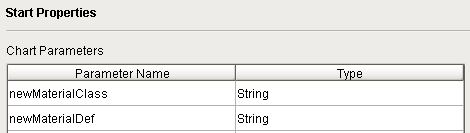
- This chart receives two Chart Parameter values from the calling script (newMaterialClass = 'Flour' and newMaterialDef = 'Whole Wheat').
- A Script Block in the chart writes those values to Tags x1 and x2.
Chart Parameters Defined in Start Block
Code Snippet -- from a chart Script Block
Code |
|
Code Snippet -- from a Button
Code |
|
Output
Code |
Tags x1 and x2 were written by a Business Connector chart's Script Block (chart parameter values passed into the chart) Tags x3 and x4 were written from within an Ignition Button script (using chart parameter values returned by the chart) (see tags below) |
Ignition Tags

executeChartSynchronous(chartPath, chartParameters, returnChartParameters)
Description
Execute a Business Connector Chart. Passes a Python dictionary of Chart Parameter value(s) into the chart and waits for a Python dictionary of the final Chart Parameter value(s) to be returned upon completion of chart execution. This function will wait for the chart to complete execution before returning control to the calling script (and returns a Python dictionary).
Syntax
executeChartSynchronous(chartPath, chartParameters, returnChartParameters )
- Parameters
String chartPath - The path of the Chart in the Business Connector section of the Ignition Project Browser.
Object chartParameters - A Python dictionary of Chart Parameter name(s) and value(s) to pass into the chart (may be a subset of all available Chart Parameters for the chart). The Chart Parameters must be defined in the chart's Start Block or an exception will be thrown.
String or Object returnChartParameters - Either a string (containing one Chart Parameter name) or a Python list of Chart Parameter names to have values returned by the chart upon the completion of execution of the chart (may be a subset of the available Chart Parameters for the chart). The Chart Parameters must be defined in the chart's Start Block or an exception will be thrown.
- Returns
Object A Python dictionary of the requested Chart Parameter name(s) and value(s).
- Scope
All
Code Examples
Chart Execution With Parameters Passed In and Returned
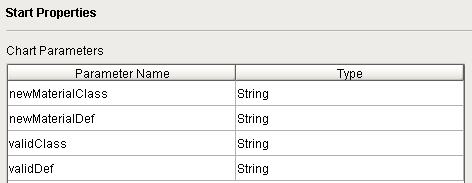
- This chart receives two Chart Parameter values from the calling script (newMaterialClass = 'Flour' and newMaterialDef = 'Whole Wheat').
- A Script Block in the chart writes those values to Tags x1 and x2.
- The Script Block then writes to two other Chart Parameters, which will be returned to the calling script in the button when chart execution concludes (validClass = 'Bread' and validDef = 'Raisin')
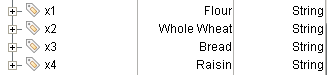
- The button script writes the returned values to Tags x3 and x4 to demonstrate that the values were properly returned by the chart function.
Chart Parameters Defined in Start Block
Code Snippet -- from a chart Script Block
Code |
|
Code Snippet -- from a Button
Code |
|
Output
Code |
Tags x1 and x2 were written by a Business Connector chart's Script Block (chart parameter values passed into the chart) Tags x3 and x4 were written from within an Ignition Button script (using chart parameter values returned by the chart) (see tags below) |
Ignition Tags
Other Examples
The Chart Parameter(s) to be returned by the script function can be either a Python list, or a single string with either the name of one Chart Parameter to be returned, or an asterisk (return all Chart Parameters). Returned Chart Parameter(s) is/are in the form of a Python Dictionary, such as: {"name":"John Smith", "id":12345} or {'Bob': 89.9, 'Joe': 188.72, 'Sally': 21.44}.
Python list (return just these Chart Parameters)
Code |
r = system.mes.bc.executeChartSynchronous(chartPath, parameterValues, ['param1', 'param2']) p1 = r['param1'] p2 = r['param2'] |
String with one Chart Parameter name
Code |
r = system.mes.bc.executeChartSynchronous(chartPath, parameterValues, 'param2') p2 = r['param2'] |
Asterisk (return all Chart Parameters --- in this example there are four)
Code |
r = system.mes.bc.executeChartSynchronous(chartPath, parameterValues, '*') p1 = r['param1'] p2 = r['param2'] p3 = r['param3'] p4 = r['param4'] |
Sepasoft MES Module Suite